SouthWest England part II
Part 2: Cornwall ice cream home-stay and Cornish coastal driving
We continued our trip into Cornwall, the farthest south west corner of England. You can probably figure out for yourself that according my my New England analogy, Cornwall is Maine–coastal villages, funny accents, pasties instead of lobsters, and a lot of nothing inland.
We began our time in Cornwall with another week long homestay: this time at a dairy farm where they made luxury ice cream. Our actual tasks at the farm were rather menial– mostly we did a lot of filling and emptying the dishwasher, and I did a lot of ironing while Dominic was busy weed whacking. However, the perks were great– fresh milk all you can drink any time, and ice cream every evening. We even got to try our hands at building our own flavors! I made an acceptable rhubarb blueberry ginger, and Dom made a morish peanut-butter-fudge.
A few days after we got there we took a day off to visit the Eden Project. The main attraction to the Eden Project are two large greenhouses (one is the largest in the world) which contain information and plants from the Mediterranean and the tropics. These were nice enough, but the most interesting parts were the outside parts– full of information about Cornish plants, the history of plants and flowers, and most interestingly human uses of plants.
After at week at the ice cream farm, we headed off for a road trip south along basically the entire coast line of Cornwall. One of our goals while in Cornwall was to try as many of of the best pasties (according to Lonely Planet) as possible. Another goal was to eat the best Fist and Chips in England, at celebrity chef Rick Stein’s fish and chip shop in Padstow. Parking in Wadebridge, we had a 3 mile hike along an estuary and tidal river to Padstow to work up an appetite. It is crazy for my Michigan brain to see the tide rise and fall in a river.
Continuing southwest along the coast was an endless stream of lovely white sand beaches, cute touristy towns, and pasties to be had in every village. One that sticks out in my mind is St. Ives. Like many of these coastal towns it was built on the hillside, tumbling down to the shore. Lichens and mosses on the roofs cause all the houses to have a green or orange roof, contrasting with the brightly colored paint jobs.
St. Ives was the gate onto our Prehistoric Penwith Peninsula tour. Iron age, Roman, and 19th Century Mining ruins sit side by side on this little strip of land. The oldest sites are mostly stone circles (like a tiny version of stonehenge) and “quoits”. A quoit is a slab of stone set on top of a few other stones. Another interesting site we found is the holed rock at Men an Tol. I climbed through it to try to cure my rickets, but apparently legend is actually that you need to climb through it 7 times at sunset, so no luck. At the far south point of Penwith we attended Our Town at the Minack open-air theater. The full moon and waves crashing on the rocks were so amazing it was hard to keep my attention focused on the play.
Around the corner from Penwith is the Lizard Penninsula– a lighthouse, tourist trap, and preserve marking the farthest south point in England (excepting islands).
Driving north again, just before heading back into Devon we stopped in Plymouth. For a bigger city, Plymouth was nice. The day we were there there happened to be a sailboat race in the harbour, which meant the city was full of festive zooiness. There is a nice open space up on a hill with a relocated lighthouse in the middle and a still-in-military-use fort on one side. Down on the waterfront, it was personally exciting to see the Mayflower Steps, and see the name of my forefather engraved in stone there. And thus concluded our Cornwall coastal circuit.
-
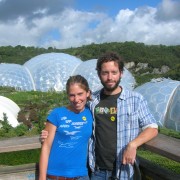
- The Eden Project
-
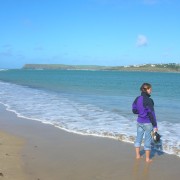
- On a beach
-
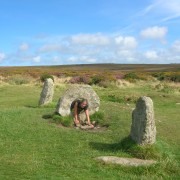
- Men an Tol
-
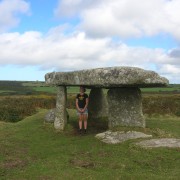
- Lanyan Quoit
-
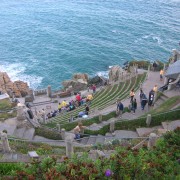
- Minack Theater
-
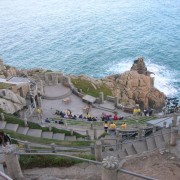
- Minack Theater
-
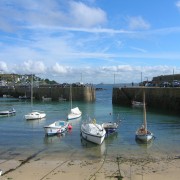
- Harbour and blue skies
-
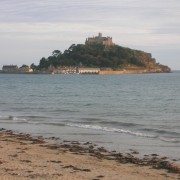
- St Clemens Isle
-
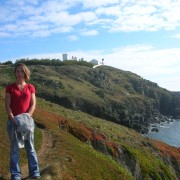
- Lizard Point
-
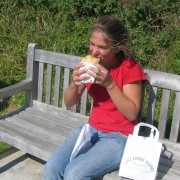
- I said I ate a lot of pasties
-
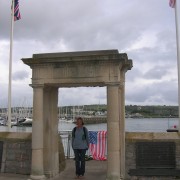
- Mayflower Steps
-
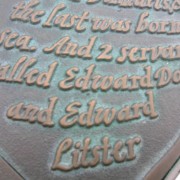
- Edward Doty